Checking the clock and wondering how long until 3:30 PM is something almost everyone does. Maybe you’re waiting for a meeting to end, a class to finish, or a friend to call.Maybe school pickup is at 3:30 PM, or your flight boards right after.
The answer is simple once you know your current time. Just subtract your current time from 3:30 PM to get the hours and minutes left.If it’s already past 3:30 PM today, the countdown shifts to 3:30 PM tomorrow instead.
Why So Many People Ask: How Long Until 3:30 PM
This question shows up in search engines constantly because it fits so many everyday situations.
Someone finishing a work meeting might be watching the clock, hoping it wraps up on time.
A student could be waiting for class to end so the school day is finally over.
Parents often count down to school pickup, especially on busy afternoons.
Athletes may have practice starting right at 3:30 PM, and coaches expect punctuality.
Professionals sometimes prepare for a presentation scheduled for that exact time.
Others are simply waiting for coffee with a friend, which can feel just as important as any meeting.
Unlike asking about tomorrow’s weather, this question is about right now. It’s about the small stretch of time between this moment and something that matters to you.
How to Calculate How Long Until 3:30 PM
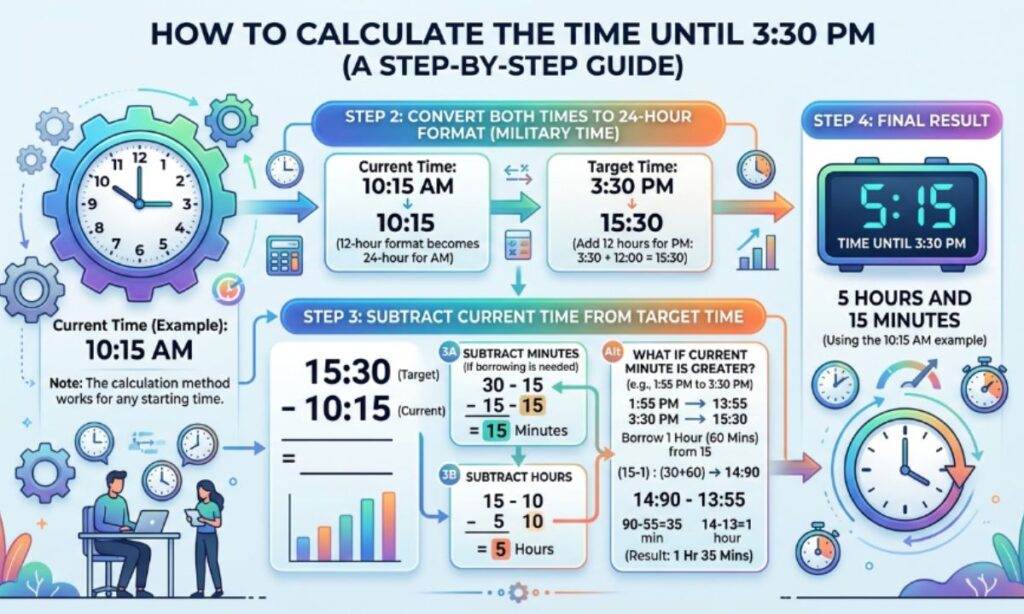
The easiest method does not need an app or a calculator.
Start by checking your current local time.
Then subtract that time from 3:30 PM.
Here is how that works in practice:
- At 2:00 PM, you have 1 hour and 30 minutes left.
- At 2:30 PM, exactly 1 hour remains.
- At 2:45 PM, there are 45 minutes left.
- At 3:00 PM, only 30 minutes remain.
- At 3:15 PM, you are 15 minutes away.
- At 3:25 PM, just 5 minutes remain.
- At 3:29 PM, only 1 minute is left.
Once the clock hits 3:30 PM, the countdown reaches zero.
The math is basic subtraction. But when you’re nervous before an interview or excited about seeing someone, even simple subtraction can feel harder than it should.
How Long Until 3:30 PM Today Using Common Examples
Here are more everyday examples people search for, laid out clearly.
| Current Time | Time Until 3:30 PM |
| 2:00 PM | 1 hour 30 minutes |
| 2:31 PM | 59 minutes |
| 2:32 PM | 58 minutes |
| 2:35 PM | 55 minutes |
| 2:40 PM | 50 minutes |
| 2:45 PM | 45 minutes |
| 2:50 PM | 40 minutes |
| 3:00 PM | 30 minutes |
| 3:15 PM | 15 minutes |
| 3:25 PM | 5 minutes |
| 3:29 PM | 1 minute |
If your clock already shows 4:00 PM, then 3:30 PM has already passed for today. Your countdown moves to tomorrow instead.
Using a Countdown Timer Makes Life Easier
Manual math works fine for quick checks, but most people prefer a countdown timer because it removes all the guesswork.
A digital countdown clock updates every second and shows the exact time remaining without you doing any subtraction.
Common tools people use include:
- Online timers built into browsers or search engines
- Digital countdown clocks on phones and computers
- Live countdown widgets on websites
- Smartphone timer apps
- Smartwatch countdown features
These tools calculate the time difference automatically, so you never have to wonder whether there are 2 minutes or 49 seconds left.
Why Local Time Matters
Not everyone reaches 3:30 PM at the same moment.
Someone in Karachi experiences the afternoon hours several hours before someone in New York or London.
That is why most countdown tools detect your local time zone automatically and calculate the remaining time based on where you actually are.
This matters most when scheduling something across regions, like an online class or an international call.
Ignoring time zones is one of the fastest ways to cause confusion when coordinating with someone far away.
A meeting invite that says “3:30 PM” without a time zone attached can easily lead to one person showing up an hour early or late.
Most calendar apps now attach a time zone automatically, but it still helps to double check before confirming plans with someone in a different region.
Understanding Time Formats
Many people also want to know how 3:30 PM looks in other time systems, especially for travel or work.
Here is the comparison:
- 12-hour clock: 3:30 PM
- 24-hour time: 15:30
- Military notation: 1530
A few more examples for context:
- 2:30 PM becomes 14:30
- 6:30 AM stays 06:30
- 10:30 PM becomes 22:30
Knowing these formats helps with travel bookings, healthcare appointments, aviation schedules, and international business communication, where 24-hour time is the standard.
Everyday Reasons People Wait for 3:30 PM
Not every countdown carries the same emotional weight.
Sometimes 3:30 PM means freedom, like the end of a school day.
Sometimes it means responsibility, like the start of a shift.
Sometimes it just means excitement, like a long-awaited phone call.
Common reasons people watch the clock for 3:30 PM include:
- School dismissal, when kids are finally free for the day
- An afternoon workout squeezed between other tasks
- A virtual meeting that needs full attention
- A coffee break that offers a short mental reset
- A medical appointment that requires being on time
- Flight check-in before a trip
- A family gathering starting in the late afternoon
- A birthday celebration kicking off early
- A job interview that could change everything
- A project milestone deadline at work
Two people can stare at the same clock and want completely opposite outcomes from the same 30 minutes.
How Long Until 3:30 PM Tomorrow?
If it is already evening, say 4:30 PM, 6:30 PM, 8:30 PM, or 10:30 PM, then today’s 3:30 PM has already passed.
Your countdown now points to tomorrow.
For example, from 10:30 PM tonight, you are roughly 17 hours away from 3:30 PM tomorrow.
A few more reference points:
- From 6:30 PM tonight to 3:30 PM tomorrow is about 21 hours.
- From midnight to 3:30 PM the same day is 15 hours and 30 minutes.
A future time calculator handles these longer countdowns instantly, without needing you to count hours by hand.
Digital Tools That Simplify Time Tracking
Technology has made waiting far more organized than it used to be.
Some of the most useful tools include:
- Clock calculators for quick time math
- Duration calculators for measuring time between two points
- Future time calculators for planning ahead
- Calendar reminders that alert you in advance
- Smart assistants that answer time questions by voice
- Wearable devices that track time throughout the day
- Browser countdown widgets for quick glances
Many people pair these tools with basic scheduling habits, like blocking out focused work time, so they check the clock less often out of anxiety and more often out of routine.
Real-Life Situations Where Every Minute Counts
Consider a few situations where the countdown really matters.
A teacher preparing an afternoon lesson checks the time at 2:50 PM and sees 40 minutes left to finish planning.
A manager glances at the clock at 3:15 PM before a client call and has just 15 minutes to prepare.
A parent waiting outside a school checks the time at 3:25 PM, knowing children will come through the gates in 5 minutes.
Each of these moments feels different, even though the math behind them is exactly the same.
That is one of the small paradoxes of time. The numbers do not change, but how they feel always does.
Planning Around 3:30 PM
If your afternoon revolves around a 3:30 PM deadline or appointment, planning backward can help reduce stress.
| Task | Suggested Time |
| Review emails | 2:00 PM |
| Finish focused work | 2:30 PM |
| Prepare meeting notes | 2:45 PM |
| Final review | 3:15 PM |
| Wrap up loose tasks | 3:25 PM |
| Ready by | 3:30 PM |
Working backward from your target time gives each task its own space instead of letting everything compete for the same final minutes.
How Countdown Calculators Actually Work
A countdown calculator follows a simple process behind the scenes.
It reads your current time, today’s date, your local time zone, and the target time you want to count down to.
From there, it continuously calculates the time remaining in hours, minutes, and seconds, updating every second until it hits zero.
The process is just arithmetic running in the background. But watching the numbers count down still makes the wait feel more real and more manageable.
Time Awareness Improves Productivity
Many productivity experts point to time awareness as a simple but powerful habit.
Instead of thinking vaguely that you will finish something later, knowing you have exactly 24 minutes or 45 minutes left before 3:30 PM encourages sharper decisions about what to prioritize.
Useful habits that build this awareness include:
- Setting a smartphone alarm for key transitions
- Using recurring reminders for repeated tasks
- Tracking progress with a simple timer
- Creating a basic daily schedule
- Reviewing your daily routine each morning
- Using a schedule planner to block out time
Small habits like these tend to add up to noticeably better time management over weeks and months.
The goal is not to become obsessed with the clock. It is to stop losing track of it entirely, since that is usually what leads to rushed decisions and missed deadlines in the first place.
People who build strong time awareness tend to feel less rushed overall, even on busy days, simply because they know roughly how much time each task actually needs.
Examples Across Different Dates
Sometimes a countdown to 3:30 PM is not just about today. It is tied to a specific future date, like an appointment or event.
The same subtraction method applies no matter the date, whether it falls on a Saturday, a weekday in June, or a holiday later in the year.
Whether you are counting down to an anniversary, a birthday, a holiday, an interview, or the start of a vacation, the calculation stays the same.
The calendar date changes. The math behind the countdown does not.
Frequently Asked Questions
How many hours until 3:30 PM?
It depends on your current time. Subtract your current hour and minute from 3:30 PM to get the exact answer.
What time is 3:30 PM in military time?
3:30 PM is written as 1530, or 15:30, in 24-hour and military time formats.
What’s the easiest way to calculate time until 3:30 PM?
Use an online timer or countdown calculator. These update automatically every second so you do not need to do the math yourself.
Why does my countdown differ from someone else’s?
Different time zones and local times explain almost every difference between two people’s countdowns.
Can I create reminders?
Yes. Most smartphones let you set alarms, calendar alerts, and countdown widgets that notify you before 3:30 PM arrives.
How long until 3:30?
The time left depends on your current local time. A live countdown tool shows the exact hours, minutes, and seconds remaining.
How long until 3 30?
Compare your current time with 3:30 to find the difference. An online countdown updates this automatically as time passes.
How long until 3:30 pm?
The countdown changes every second based on your local time zone. A live timer gives the most accurate remaining time.
How much time until 3:30 pm?
This depends on where you are and what time it is right now. A real-time countdown shows the exact duration instantly.
Time until 3:30?
This is found by calculating the difference between your current time and 3:30. A countdown timer keeps this updated continuously.
Making Better Use of the Waiting Time
Instead of refreshing the clock every few minutes, use the time before 3:30 PM with a clear purpose.
A few practical ideas:
- Clear your inbox with quick email replies
- Stretch or move around before a workout
- Organize documents for administrative tasks
- Prepare notes for an upcoming presentation
- Review material before an online class
- Finish one piece of focused work
- Pack ahead of upcoming travel
- Double-check a medication schedule
- Update your planner for the rest of the day
- Take a few minutes to simply breathe
Waiting feels much shorter once your attention has something meaningful to focus on.
Conclusion
Asking how long until 3:30 PM might seem like a small question, but it usually points to something bigger. Every countdown reflects hope, responsibility, excitement, or preparation.
Whether you calculate the time difference by hand, use a live countdown tool, or check a digital clock, you are really measuring the distance between now and something that matters to you.
The next time you glance at the clock and see 2:40 PM, 2:50 PM, 3:15 PM, or even 3:29 PM, remember that every minute has its own quiet purpose.
Use the time you have left with intention, stay aware of your schedule, and let the countdown motivate you instead of stressing you out. Time keeps moving whether you watch it or not, and 3:30 PM always arrives right on cue.

Pastor John is a devoted spiritual guide with years of experience in ministry and biblical teaching. Passionate about helping others grow in faith, he shares practical insights, prayer guidance, and reflections from the Bible to inspire a closer relationship with God. His writings aim to encourage, uplift, and lead readers on a path of spiritual growth and inner peace.