You check the clock, expecting real progress, and it’s only moved two minutes. That small moment is usually what sends people searching for one simple answer: how long until 2:30 PM.
The question shows up more often than you’d think. Maybe you’re waiting on a meeting, watching the clock before a doctor’s appointment, or just counting down to your afternoon break. Whatever the reason, knowing the exact time remaining helps you plan the next hour instead of guessing at it.
How Long Until 2:30 PM? Understanding the Basics
The answer changes depending on one thing only: your current time.
If it’s 1:30 PM, you have exactly 1 hour left. If it’s 2:00 PM, that drops to 30 minutes. By 2:25 PM, you’re down to just 5 minutes. And if the clock already shows 2:35 PM, then 2:30 PM has come and gone for today. Your next target becomes 2:30 PM tomorrow, unless you had a different date in mind.
Every calculation like this starts with two values:
- Current time — where the clock stands right now
- Target time — the moment you’re counting toward, in this case 2:30 PM
The difference between those two numbers is your time remaining. Some people call it the time gap, others say duration, but it’s really just one countdown by a different name.
This question tends to show up in a few common forms:
- How long until 2:30 PM today?
- How many minutes until 2:30 PM?
- How many hours until 2:30 PM?
- What time is left before 2:30 PM?
How Long Until 2:30 PM Using Manual Time Calculation
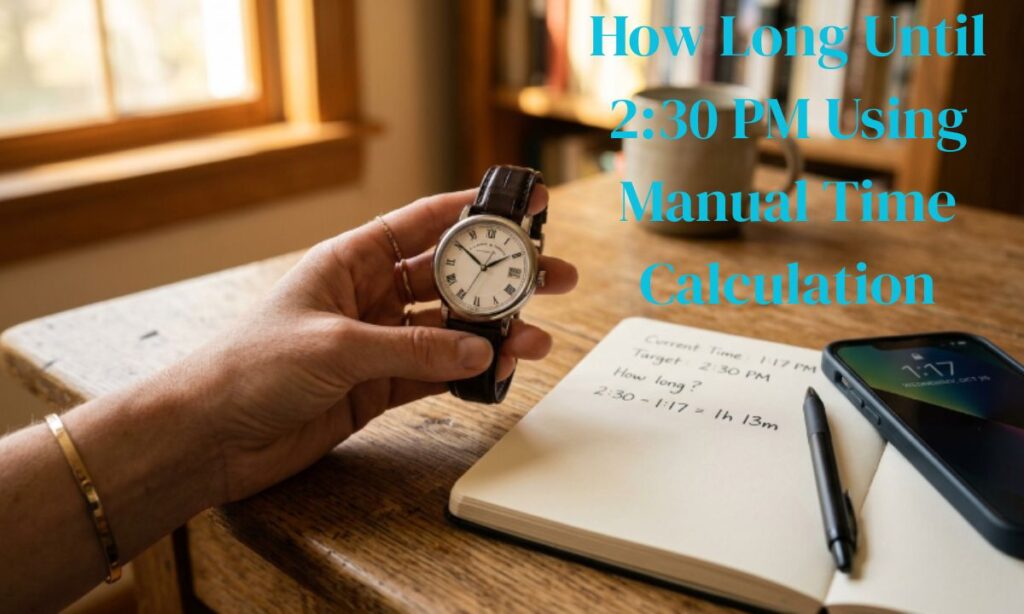
You don’t always need an app for this. A quick mental calculation often gets you the answer faster than opening your phone.
Here’s how it works with a few examples:
| Current Time | Time Remaining Until 2:30 PM |
| 1:30 PM | 1 hour |
| 1:45 PM | 45 minutes |
| 2:00 PM | 30 minutes |
| 2:10 PM | 20 minutes |
| 2:20 PM | 10 minutes |
| 2:25 PM | 5 minutes |
| 2:29 PM | 1 minute |
The steps are simple:
- Note your current time.
- Compare it against the target time, 2:30 PM.
- Work out the difference in hours and minutes.
This is manual time calculation. It’s an old habit, but it still holds up, and it’s a useful skill to have even when tools are just a tap away.
Take an example. Say your watch reads 1:48 PM. Subtract that from 2:30 PM in two steps:
- From 1:48 PM to 2:00 PM = 12 minutes
- From 2:00 PM to 2:30 PM = 30 minutes
Add those together and you get 42 minutes remaining.
Why People Search “How Long Until 2:30 PM”
At first glance, it seems like an odd thing to search for. But people type this exact question into Google for dozens of different reasons every day.
An office worker might have a presentation scheduled for 2:30 PM. A student could be waiting for afternoon classes to start. A parent might be counting down to school pickup time. Someone else could have a doctor’s appointment, a client call, or a job interview beginning right at 2:30 PM.
Even smaller things count. A planned lunch break or an afternoon coffee run can make that hour feel worth tracking.
Some common situations where this question comes up:
- Getting ready for a work meeting
- Waiting on a performance review
- Joining a virtual conference call
- Watching the clock before flight boarding
- Starting a focused study session
- Reviewing a project deadline
- Waiting for a family gathering to begin
- Preparing for an online event
The clock itself never changes speed. What changes is why we’re watching it.
Best Tools to Check the Time Until 2:30 PM
Technology has made this almost too easy. Instead of doing the math yourself, plenty of tools can show you the exact time remaining, updating down to the second.
Some popular options:
- Countdown timer – shows hours, minutes, and seconds counting down live
- Countdown clock – a simple visual display for tracking a fixed target time
- Digital timer – handy for short, precise countdowns
- Online countdown timer – no app needed, works straight from your browser
- Browser countdown widget – stays visible on your screen while you work
- Desktop timer – useful if you’re at a computer most of the day
- Mobile timer – built into most phones, easy to set in seconds
- Calendar reminder – alerts you ahead of time, so you’re not caught off guard
- Smartphone clock – often has a built-in countdown or alarm feature
- Smartwatch countdown – convenient if you’re away from your phone
Most of these tools adjust automatically for your local timezone, so you get an accurate countdown without setting anything manually.
If your day is packed with back-to-back commitments, pairing a calendar reminder with a countdown clock works well. It’s a small habit, but it saves you from the last-minute scramble when you realize a meeting started five minutes ago.
How Long Until 2:30 PM and Better Time Management
Knowing your time remaining isn’t just about satisfying curiosity. It’s a practical part of managing your day well.
Say it’s 1:45 PM and your meeting starts at 2:30 PM. You immediately know you have 45 minutes to work with.
That’s enough time to:
- Finish replying to a few emails
- Review your notes before the meeting
- Complete one small, focused task
- Grab a quick snack
- Tidy up your workspace
- Get your documents ready
- Stretch for a couple of minutes before diving back in
Instead of wondering whether you have “enough time,” you already know the number, and that makes planning the next block far easier.
This is part of why time tracking, task management, and time blocking work so well together. A fixed target time turns a vague deadline into something visible, which naturally cuts down on procrastination.
Interestingly, having just twenty minutes left often pushes people to work faster than having two full hours would. A tighter window seems to sharpen focus, even if it doesn’t feel fair at the time.
How Long Until 2:30 PM in Your Daily Routine
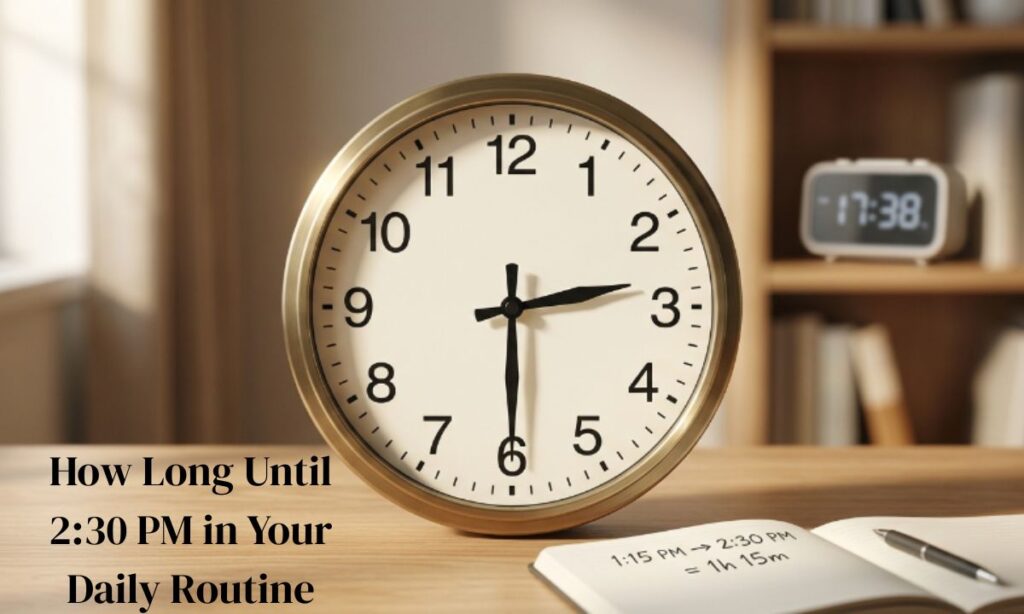
Most people don’t wake up thinking about 2:30 PM specifically. But by early afternoon, that hour often becomes a natural checkpoint in the day, whether it’s the end of something or the start of what comes next.
Knowing how long until 2:30 PM shapes the rest of the afternoon more than people usually notice. For a lot of routines, this single point on the clock quietly holds everything together.
For many, 2:30 PM marks the end of a lunch break, the start of a client presentation, or the moment to head out for a doctor’s appointment. Others treat it as a natural point to reset their energy before pushing through the rest of the workday.
A few everyday examples:
- An employee preparing for a status update with their manager
- A student getting ready for afternoon classes or an exam
- A parent planning ahead for school pickup
- A traveler tracking the countdown before flight boarding
- Someone joining a virtual conference from home
- A freelancer starting an important focus session
- A family waiting on a celebration to begin
- A patient heading out for a scheduled appointment
Every schedule looks different, but the underlying idea stays the same. Knowing your remaining time lets you prepare calmly instead of scrambling at the last minute.
The Psychology of Waiting
Here’s something worth noticing. Ten minutes can fly by when you’re watching a good movie, yet those same ten minutes can drag on forever when you’re waiting for an interview to start. Clocks measure time the same way every time. Our brains don’t.
Researchers who study time perception have found that emotions play a big role in how fast or slow time seems to move. When we’re nervous, excited, or impatient, the minutes seem to stretch out longer than they actually are.
Some common emotions tied to waiting:
- Anticipation, which makes each minute feel more significant
- Excitement, which can make time feel like it’s crawling
- Impatience, which sharpens your awareness of every passing second
- Curiosity, which keeps your attention locked on the clock
- Motivation, which can shift how urgent the wait feels
Think about waiting until 2:30 PM for a job interview. Every glance at the clock feels weighty. Now compare that to spending the afternoon catching up with a friend, where suddenly it’s 3:00 PM and you barely noticed the time pass.
That gap is exactly why a visible countdown clock can ease some of that tension. Instead of checking the time over and over, you glance at it once and get back to what you were doing.
Productivity Tips While Waiting Until 2:30 PM
Rather than watching the clock every few minutes, it helps to put that waiting time to use. Even a short window can get more done than people expect.
If you’ve got an hour before 2:30 PM, consider using it for:
- Finishing a small work assignment
- Tidying up your desk or workspace
- Reviewing notes ahead of your meeting
- Reading a chapter of a book
- Fitting in a quick workout
- Clearing out your inbox
- Mapping out tomorrow’s schedule
- Getting your presentation materials in order
Working in focused intervals tends to work better than trying to power through the whole stretch at once. A study timer or productivity timer can help you stay locked in without constantly glancing at the clock.
This approach pairs naturally with a few well-known habits:
- Time blocking, which splits your day into focused chunks
- Task management, which keeps your priorities in order
- Productivity tracking, which shows you where your time actually goes
Once you know exactly how much time you have left before your next commitment, it’s much easier to pick a task that actually fits the window, instead of starting something you’ll have to rush through.
Countdown Tools That Make Life Easier
You don’t need to do manual time calculation every single time you wonder how much time is left. Plenty of digital tools handle the math for you, working out the difference between your current time and your target time in an instant.
Some popular choices:
- Countdown timer – a straightforward way to watch time tick down live
- Online countdown timer – works from any browser, no installation needed
- Countdown clock – good for keeping a target time visible at all times
- Digital timer – useful for short, exact countdowns
- Real-time timer – updates continuously without any manual refresh
- Browser countdown widget – sits on your screen while you work on other things
- Desktop timer – convenient for anyone working at a computer most of the day
- Mobile timer – already built into most phones, quick to set up
- Smartphone clock – often doubles as a basic countdown tool
- Smartwatch countdown – handy when your phone isn’t within reach
- Calendar reminder – gives you a heads-up before the moment arrives
- Productivity software – some tools combine countdowns with task tracking
Some people layer a few of these together. You might set a calendar reminder fifteen minutes before 2:30 PM, while also keeping a countdown clock open on your screen as a visual backup.
This combination works especially well if your day is full of appointments, since it gives you more than one chance to catch an upcoming deadline before it sneaks up on you.
Manual vs. Automatic Time Calculators
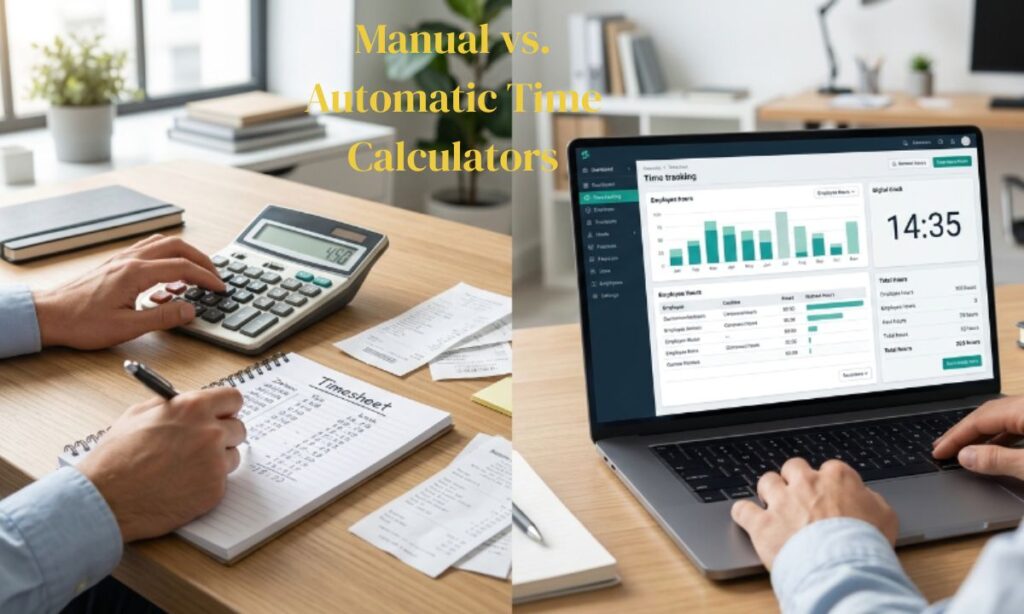
There’s no single right answer here. It really comes down to what you need in the moment.
An automatic time calculator gives you an instant, accurate result without any effort on your part. If precision matters, especially when you’re counting down to the second, digital tools are hard to beat.
Manual calculation has its own value too. Working it out yourself keeps your mental math sharp and gives you a better feel for how time actually adds up, rather than just reading a number off a screen.
A few commonly used calculator types:
- Time calculator – general-purpose tool for working out time differences
- Future time calculator – tells you what time it’ll be after a set duration
- Time difference calculator – built specifically to compare two points in time
- Remaining time calculator – focuses on how much time is left until a target
- Time interval calculator – measures the gap between a start and end point
Whether you reach for an app or just do it in your head, both paths lead to the same answer. The only real difference is how much effort you want to put in to get there.
Real-Life Examples
Seeing this play out with actual numbers makes it easier to picture how the calculation works in daily life.
Example 1
Current time: 1:30 PM
Target time: 2:30 PM
Time remaining: 1 hour
That’s enough room for one solid, focused work session before the clock runs out.
Example 2
Current time: 2:10 PM
Target time: 2:30 PM
Time remaining: 20 minutes
Just enough time to review your notes before hopping on a client call.
Example 3
Current time: 2:29 PM
Target time: 2:30 PM
Time remaining: 1 minute
Probably not the moment to start anything new. Better to just wait it out.
Final Thoughts
The question “How Long Until 2:30 PM?” might look simple on the surface, but it connects to a lot more than just a number on a clock. It reflects how we plan our day, manage our commitments, and even how we experience time on an emotional level.
Whether you’re preparing for a meeting, heading to a doctor’s appointment, joining a virtual conference, or just looking forward to your afternoon break, knowing your time remaining helps you stay organized instead of rushing at the last second.

Pastor John is a devoted spiritual guide with years of experience in ministry and biblical teaching. Passionate about helping others grow in faith, he shares practical insights, prayer guidance, and reflections from the Bible to inspire a closer relationship with God. His writings aim to encourage, uplift, and lead readers on a path of spiritual growth and inner peace.